
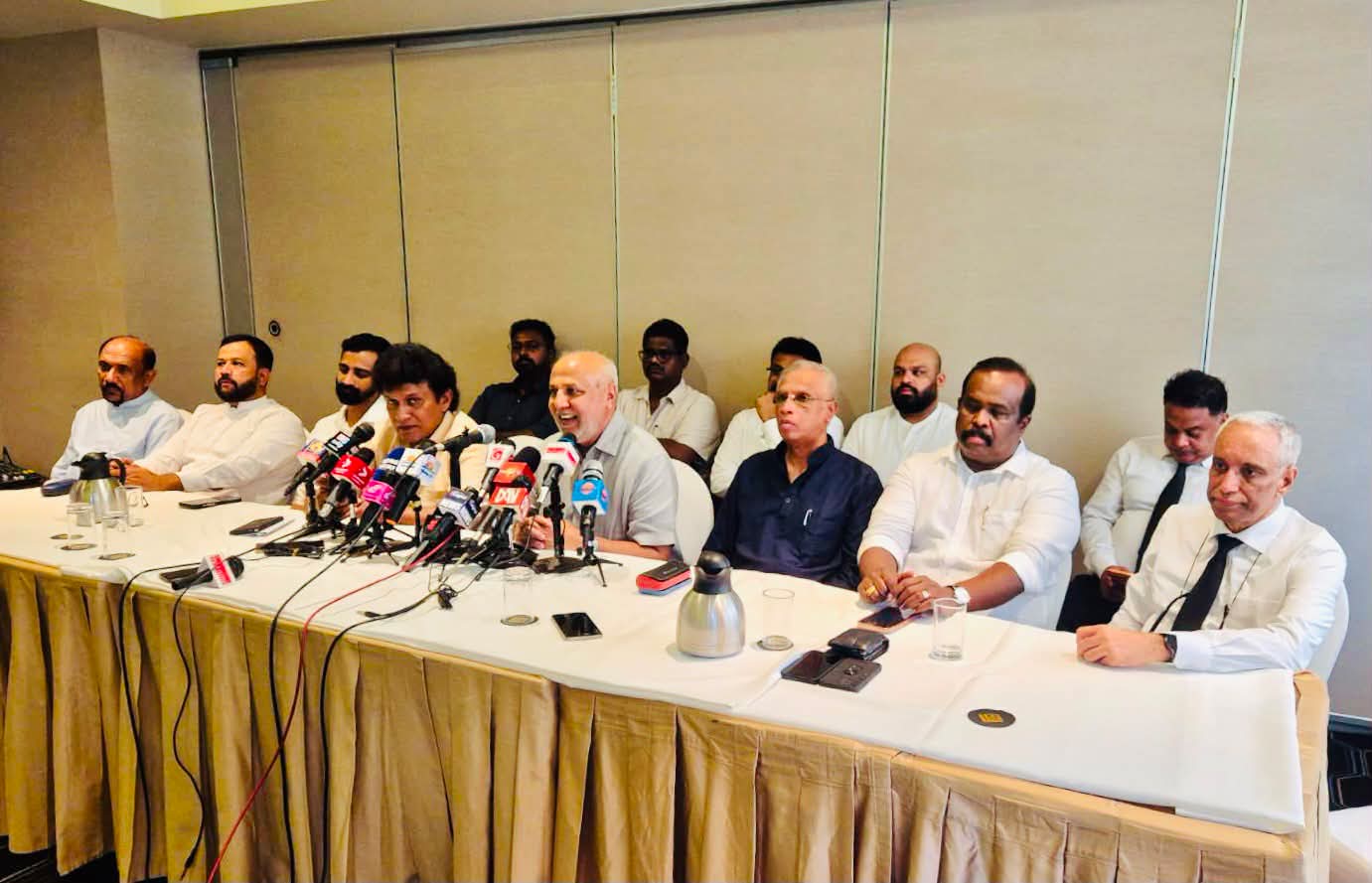
Leading representatives of six Tamil-speaking political parties, all of them in opposition, have agreed to establish a common platform to discuss shared concerns, exchange views and build consensus on the issues facing their communities, bringing together the Tamils of the North-East, the Malaiyaha Tamils of the hill country and Muslims across the island.
The agreement was announced at a press conference in Colombo on Monday, uniting the Ilankai Tamil Arasu Kachchi (ITAK), the Sri Lanka Muslim Congress (SLMC), the Tamil Progressive Alliance (TPA), the All Ceylon Makkal Congress (ACMC), the Democratic Tamil National Alliance (DTNA) and the Ceylon Workers' Congress (CWC). The ITAK parliamentarian Shanakiyan Rasamanickam has been named coordinator of the six-party initiative.
The representatives were at pains to mark the limits of what they had agreed. Each party remains free to maintain its own policies and political positions, they said, and the platform is not an electoral alliance but a mechanism to identify common ground and act on it where possible. The SLMC leader Rauff Hakeem, whose party is aligned to the main opposition Samagi Jana Balawegaya, framed the initiative as "within the broad national framework of Sri Lanka’s sovereignty and territorial integrity", and said it should not be read as an anti-government or a pro-opposition stance.
The TPA leader Mano Ganesan described its aims as a new constitutional process, early provincial council elections and land rights in the North-East and the plantations, pursued within an undivided Sri Lanka.
Three issues drew consensus. The first is a new constitution. The parties pointed to the National People's Power's August 2024 manifesto, since adopted as the government's National Policy Framework, which promised a new constitution building on the reform process begun in 2015, and agreed to make a unified call for that pledge to be honoured, stipulating the maximum possible devolution of power in a manner that ensures justice, equality and meaningful power sharing.
The second is the provincial councils, which the same manifesto promised would be elected within a year of the government taking office. Nearly two years on, no vote has been held, and the parties called unanimously for the elections to proceed without further delay. Urging the government and the president to act on both pledges, Ganesan said the Anura Kumara Dissanayake administration had yet to move on either. The councils, the sole existing vehicle for devolved power in the North-East, have stood without elected members since 2018, leaving the provinces in the hands of presidentially appointed governors, an arrangement whose consequences were on display last month when the Northern Province governor removed the elected mayor of Vavuniya and the Chavakachcheri Urban Council's vice chairman by gazette.
The third is land, and here the parties were pointed about who is taking it. The government must act, they said, to resolve the land grabs in the North-East carried out by state agencies including the Archaeology and Forest Departments, as well as by the military. The ACMC leader Rishad Bathiudeen said the question of land concerned all three groups, the Tamils and Muslims of the North-East and the Malaiyaha Tamils of the hill country. The DTNA's Vanni MP Selvam Adaikkalanathan noted that the platform also offered a chance to work through the differences among themselves over land rights, an apparent reference to the disputes between Tamils and Muslims in the North-East.
“There is no point in pushing this false narrative that we are all Sri Lankans without addressing long-pending concerns and shortcomings in areas where Tamil-speaking people live," said Jeevan Thondaman, MP and General Secretary of the CWC. "We need equitable solutions."
The ITAK general secretary M.A. Sumanthiran called the coming together historically significant, and set it in a longer lineage: his own party was formed on the cusp of the 1948 disenfranchisement of the Tamils of Indian origin, the hill country leader Savumiamoorthy Thondaman worked alongside northern Tamil leaders, and the SLMC's founder M.H.M. Ashraf backed the Tamil United Liberation Front's campaign in 1977.
"Majoritarianism is an enduring challenge in Sri Lanka," he said. "This is an effort to bring together representatives of numerically minority communities to highlight our shared concerns."
Notably absent from the platform are the Tamil nationalist parties. The Tamil National Council did not join, nor did the independent parliamentarian Ramanathan Archchuna, and the Tamil and Muslim representatives of the governing NPP were not part of it either. Asked about talks with the All Ceylon Tamil Congress led by Gajendrakumar Ponnambalam, the Eelam People's Democratic Party led by Douglas Devananda, and Archchuna, the ITAK said dialogue remained possible in future.