

A new report 'Killing Sri Lankan journalists: The Case of Nimalarajan Mylvaganam' co-authored by the International Truth and Justice Project (ITJP) and REDRESS, highlights the failures of Sri Lanka's police in investigating the 2000 murder of Tamil journalist Nimalarajan Mylvaganam.
Nimalarajan contributed to the BBC for over six years, as well as the Tamil daily Virakesari and Sinhala weekly Ravaya.
On October 19 2000, Nimalarajan was shot five times in his head and chest whilst he was in his Jaffna home. His father was knifed repeatedly whilst his mother and brother were injured by a hand grenade explosion in their living room.
The government-aligned paramilitary group the Eelam People's Democratic Party (EPDP) are suspected of carrying out the killing.
In February 2022, the Metropolitan Police’s War Crimes Team arrested a 48-year-old man in Britain over Nimalarajan's murder. The man was later released.
Director of REDRESS Rupert Skilbeck said in a press release that Mylvaganam's case shows "how countries like the UK can play a vital role in holding perpetrators of grave human rights violations accountable, when the country in question fails to act."
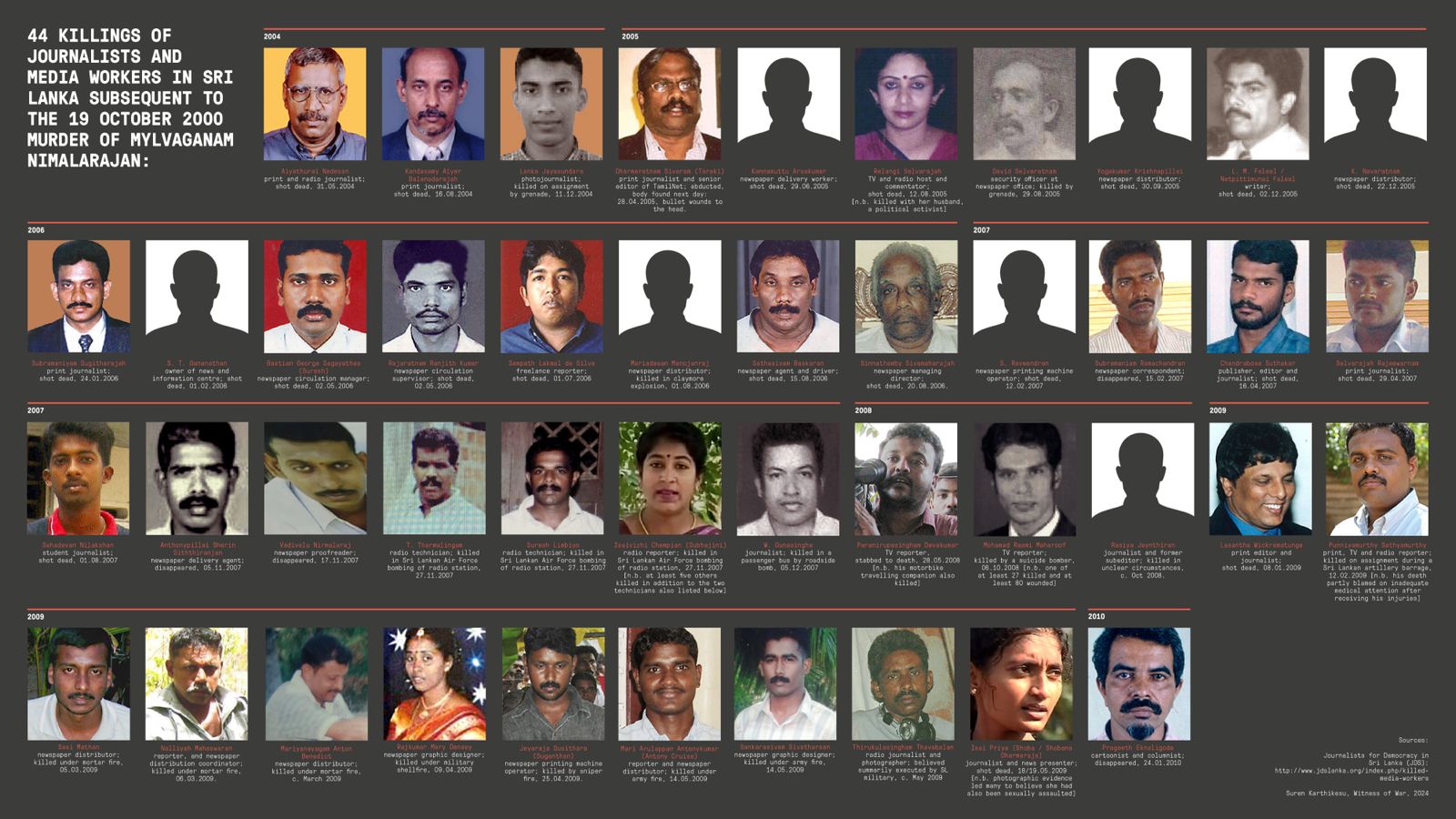
The latest report concludes that Nimalarajan's case was a "text-book case of investigative failure" and the culture of impunity allowed the murders and disappearances of 44 journalists to occur on the island between 2000 and 2010.
Investigative failures
The report draws attention to the many failures in Sri Lanka's investigation of Nimalarajan's murder, from failing to cordon off the crime scene to allowing alleged suspects to roam free and commit further murders.
Some of the failures in Nimalrajan's case include failing to secure the crime scene, not recording how many people entered the crime scene, where they went or what they touched. Moreover, the report found that there was failure to conduct a full forensic analysis of Nimalarajan's home where he was killed.
The Sri Lankan authorities also failed to pursue witness statements about the death threat Nimalarajan had received in the lead up to his murder. The report notes that in their statements to the police, several of his family members stated that Nimalarajan had received death threats, including by phone, from the EPDP before he was killed.
Before his murder, Nimalarajan was told by the manager of Lanka Telecom that the telephone numbers could not be traced. However, the report states that "it is highly likely that his phone calls were being intercepted and listened to" so this should have been checked.
The report goes on to detail how the Sri Lankan authorities also failed to fully investigate and charge identified suspects.
Culture of impunity
The report underscores that Sri Lanka's systemic failure to prosecute those responsible for Nimalarajan's murder, enabled further violations particularly against Tamil journalists in the North-East.
The ITJP and REDRESS note that in 2015, the Jaffna Press Club stated that Nimalarajan's murder had been seen as "setting the stage for violence against Tamil journalists."
Whilst various domestic commissions have been created to investigate the killings, none of them have provided any answers or justice.
To this day, journalists in the North-East are subjected to intimidation, harassment, surveillance and violence for reporting on human rights abuses in the Tamil homeland.