
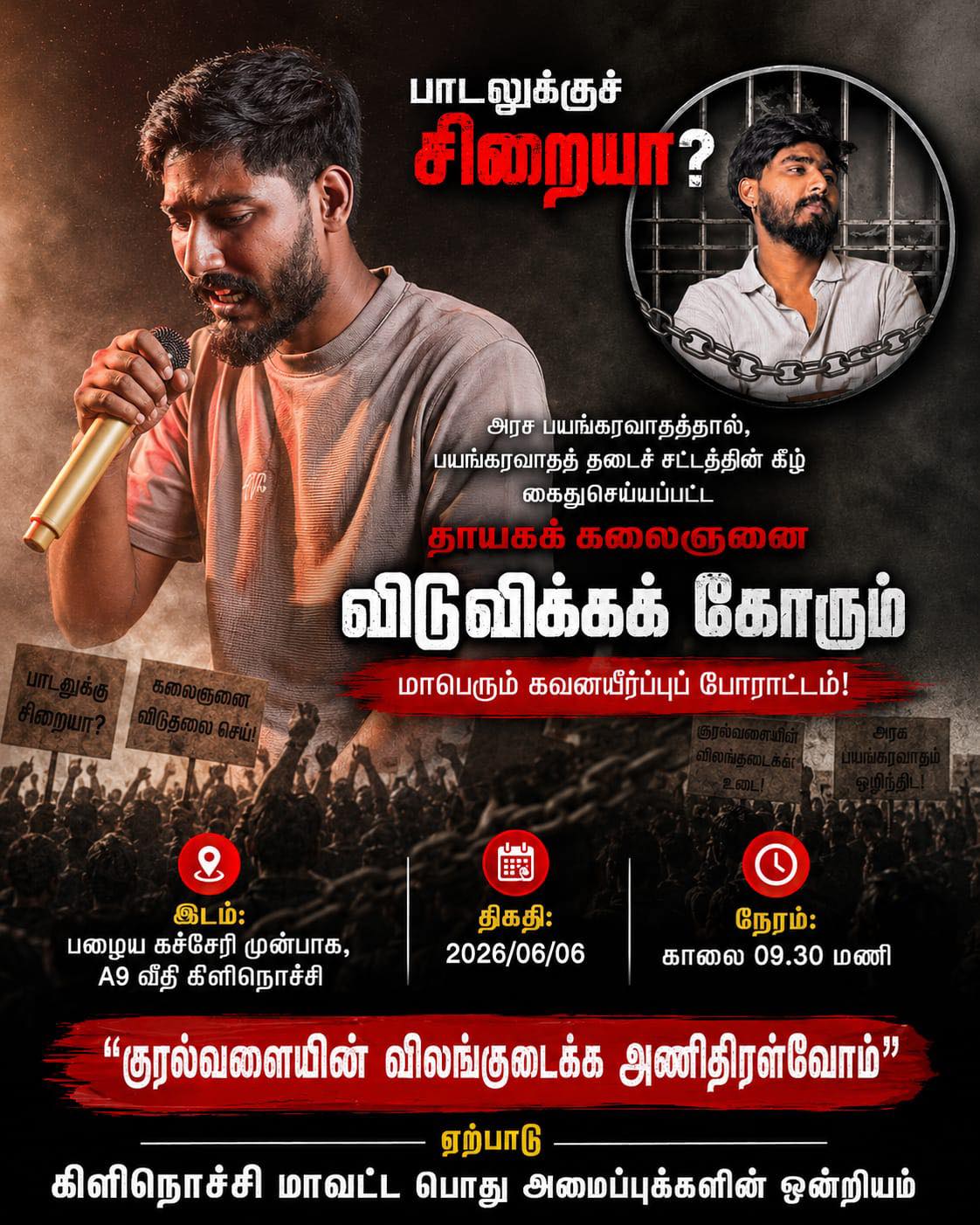
Calls for the release of Tamil rapper HipHop Sangee continued to grow this week, with Tamil civil society organisations planning a protest in Kilinochchi and parliamentarians from both Tamil and Sinhala parties raising concerns over his detention under Sri Lanka's Prevention of Terrorism Act (PTA).
The artist, whose real name is Sangeethsan Ganeskumar, was arrested and remanded after Sri Lankan authorities alleged that videos he shared on social media contained material supportive of the Liberation Tigers of Tamil Eelam (LTTE).
The 24-year-old from Udayanagar, Kilinochchi, was arrested following an investigation by the Jaffna Divisional Criminal Investigation Bureau. Police claim he edited and uploaded videos from a musical performance held in the Chavakachcheri area and presented them in a manner supportive of the LTTE.
He was subsequently produced before court under Section 03(g) of the Prevention of Terrorism Act No. 48 of 1978 and remanded until 17 June.
As criticism of the arrest mounted, Jaffna and Kilinochchi District ITAK parliamentarian S. Shritharan shared a call for a public demonstration demanding the artist's release.
The protest, organised by the Kilinochchi District Union of Civil Organisations, is scheduled to take place on 6 June in front of the Old Kachcheri on the A9 Road in Kilinochchi.
The organisers' poster describes the rapper as a "homeland artist" and states:
"Mass demonstration demanding the release of the homeland artist arrested under the Prevention of Terrorism Act by state terrorism"
Under the slogan, "Let us unite to break the chains placed on freedom of expression", the poster also asks:
"Jail for a song?"
The campaign reflects growing concern amongst Tamil activists, artists and civil society groups who argue that the continued use of anti-terror legislation against cultural and artistic expression represents a serious threat to freedom of expression in the Tamil homeland.
The arrest comes amid heightened scrutiny of Tamil cultural expression across the North-East. In recent weeks, occupying Sri Lankan police have questioned musicians and intervened in performances involving homeland-themed songs.
Last week, Gokulan, the son of the late Tamil musician S. G. Santhan, was among those summoned and questioned by police following a musical performance in Urumpirai.
Against this backdrop, Sri Lanka Podujana Peramuna (SLPP) parliamentarian Namal Rajapaksa also criticised the arrest, alleging that the government was applying the law selectively.
In a statement published on X on Thursday, Rajapaksa questioned why a young artist from Kilinochchi had been remanded under anti-terror legislation whilst members of the ruling National People's Power (NPP) had allegedly used similar themes during recent election campaigns without facing legal consequences.
"We are hearing reports that a young artist from Kilinochchi has been arrested and remanded under the PTA over the alleged use of LTTE-related material in a rap song," he wrote.
"If music and artistic expression are now being treated as terrorism-related offences, the government must explain why the same standards were not applied when NPP politicians used and shared LTTE-themed songs during the recent local government election campaign."
Rajapaksa further alleged that a Jaffna District NPP parliamentarian had openly shared similar material on social media during the campaign period, sharing a screenshot of a Tamil Guardian article.
Whilst reiterating that he and his party did not support the promotion of the LTTE, he argued that legal standards should be applied equally.
"when both a government MP and a young artist are accused of similar conduct, it is wrong for one to receive political protection while the other faces arrest under the PTA.
The law cannot be applied based on political convenience. One rule for politicians and another for ordinary youth is unacceptable in a democratic society,"
His remarks revive controversy surrounding Tamil-language campaign material circulated by NPP candidates and affiliated social media pages during recent elections. Songs shared online referenced LTTE leader Velupillai Prabhakaran, the Tamil armed struggle and themes associated with Tamil nationalism. One widely circulated campaign song drew parallels between the political ideology of the LTTE leadership and the leftist origins of the Janatha Vimukthi Peramuna (JVP), whilst another pledged to erect a statue of Prabhakaran in Valvettithurai.
Political opponents accused the NPP of exploiting Tamil nationalist sentiment during the campaign. The party nevertheless went on to make significant electoral gains in the North-East, including winning three of Jaffna District's six parliamentary seats.
But Rajapaksa’s party too has deployed a similar tactic, with Tamil candidates in the North-East under the Southern banner also playing LTTE- affiliated songs and paying tribute to LTTE figures.
The arrest of HipHop Sangee has drawn criticism from activists, journalists and civil society organisations, many of whom argue that the continued use of the PTA against artists and individuals engaged in cultural or political expression raises serious concerns over freedom of speech and the disproportionate targeting of Tamil voices.
Long criticised by international human rights organisations, the PTA grants sweeping powers of arrest and detention and has been used overwhelmingly against Tamils in the years since the end of the armed conflict.