
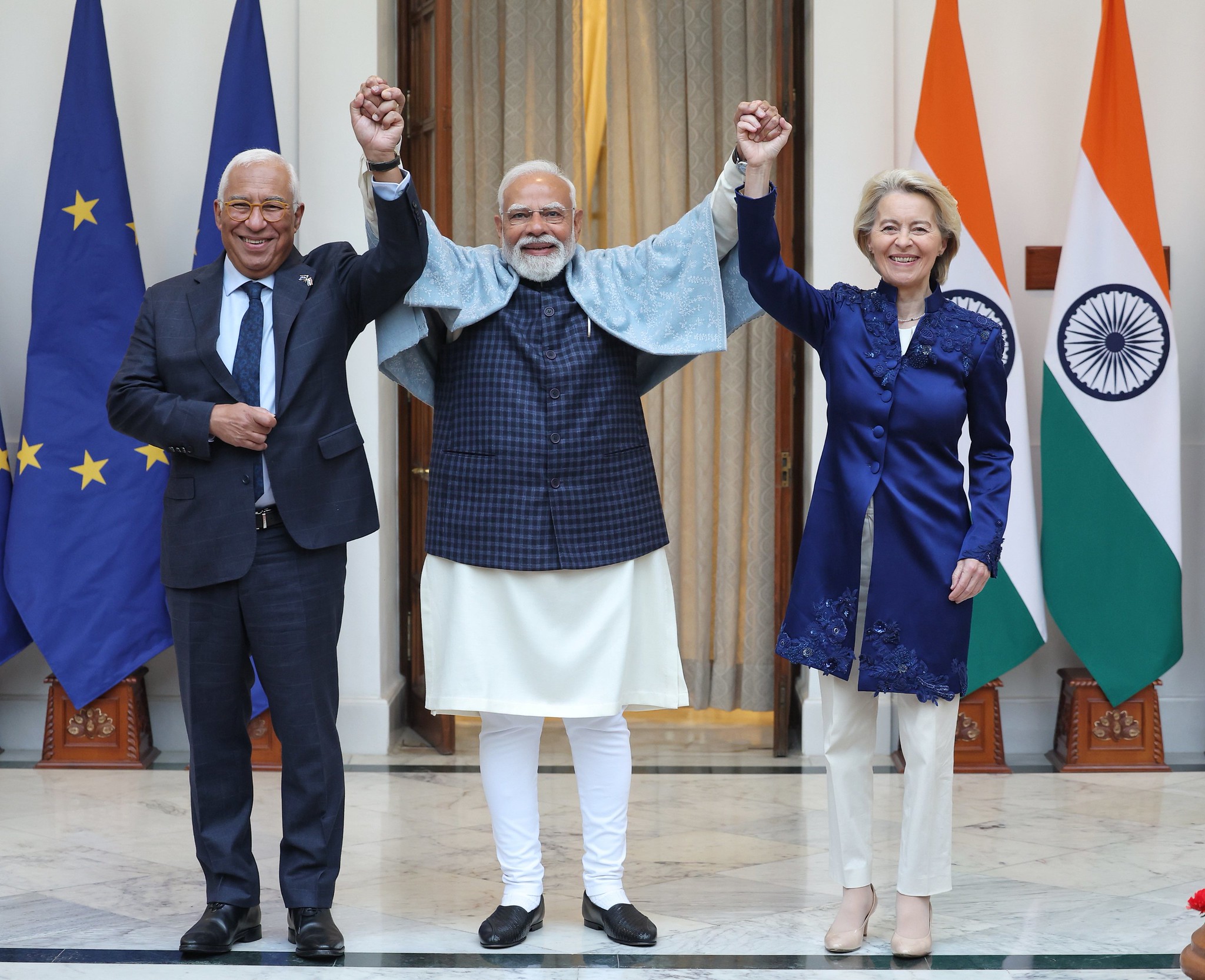
Indian Prime Minister Narendra Modi with President of the European Council, Antonio Costa & President of the European Commission, Ursula von der Leyen at Hyderabad House.
India and the European Union have announced a sweeping free trade agreement that both sides have hailed as the “mother of all deals”, concluding nearly two decades of intermittent negotiations.
The agreement was unveiled in New Delhi following a bilateral summit between Indian Prime Minister Narendra Modi and European leaders, including European Commission President Ursula von der Leyen and European Council President António Costa, who were in India as honorary guests for Republic Day.
“We did it, we delivered the mother of all deals,” von der Leyen said at a media briefing in Delhi, while Modi described the agreement as “historic”.
The deal establishes a free trade framework between the 27-nation European Union and the world’s most populous country, together accounting for nearly 25 percent of global gross domestic product and representing a combined market of close to two billion people.
“This is India’s biggest free trade agreement,” Modi said. “It will make access to European markets easier for India’s farmers and small business. It will also boost manufacturing and services sectors. It will boost innovative partnerships.”
Under the agreement, tariffs on the majority of goods traded between India and the EU will be eliminated or sharply reduced. The European Commission said it would remove duties on most exports of chemicals, machinery, electrical equipment, aircraft and spacecraft through phased reductions. Tariffs on motor vehicles, currently as high as 110 percent, will be cut to 10 percent under a quota of 250,000 vehicles, a figure significantly larger than the quota granted to the United Kingdom under its post-Brexit trade deal with India.
India, in turn, will lower tariffs on a range of European imports, including wine, beer and olive oil. Brussels said the agreement would stimulate investment flows, deepen supply chain integration and improve access to European markets.
Delhi said almost all Indian exports would receive “preferential access” to the EU market, with textiles, leather goods, marine products, handicrafts, gems and jewellery set to benefit from reduced or eliminated tariffs. While commodities such as tea, coffee, spices and processed foods will also gain improved access, the Indian government said it had “prudently safeguarded sensitive sectors, including dairy, cereals, poultry, soy meal, certain fruits and vegetables”.
The agreement also covers services, investment and mobility. The EU will open 144 services subsectors to India, while India will provide access in 102 subsectors to European firms, including in financial, maritime and telecommunications services. A new mobility framework will ease short-term travel for professionals between India and the EU.
“This free trade agreement will strengthen confidence in India for every business and every investor in the world,” Modi said. “India is working extensively on global partnerships in all sectors.”
“This is the tale of two giants – the world’s second and fourth largest economies,” von der Leyen said earlier this week. “Two giants which chose partnership in a true win-win fashion. A strong message that co-operation is the best answer to global challenges.”
European Council President Costa echoed this sentiment, stating that the agreement sent “an important political message to the world that India and the EU believe more in trade agreements than in tariffs”.
Alongside the trade pact, India and the EU are advancing talks on security, defence cooperation and climate action. India’s Defence Minister Rajnath Singh confirmed discussions with European Commission vice-president Kaja Kallas on integrating supply chains and developing defence capabilities, while negotiations continue on a draft security partnership covering maritime security and cyber threats.
The EU remains India’s largest trading partner in goods, with bilateral trade reaching $136 billion in 2024–25. Talks for a free trade agreement first began in 2007, stalled in 2013 over market access and regulatory disputes, and were formally revived in 2022.
The agreement must still be approved by the European Parliament and EU member states before it can be formally signed later this year. Despite recent opposition to other EU trade deals, the India pact is regarded as less contentious, having “cut around sensitivities on both sides”.