
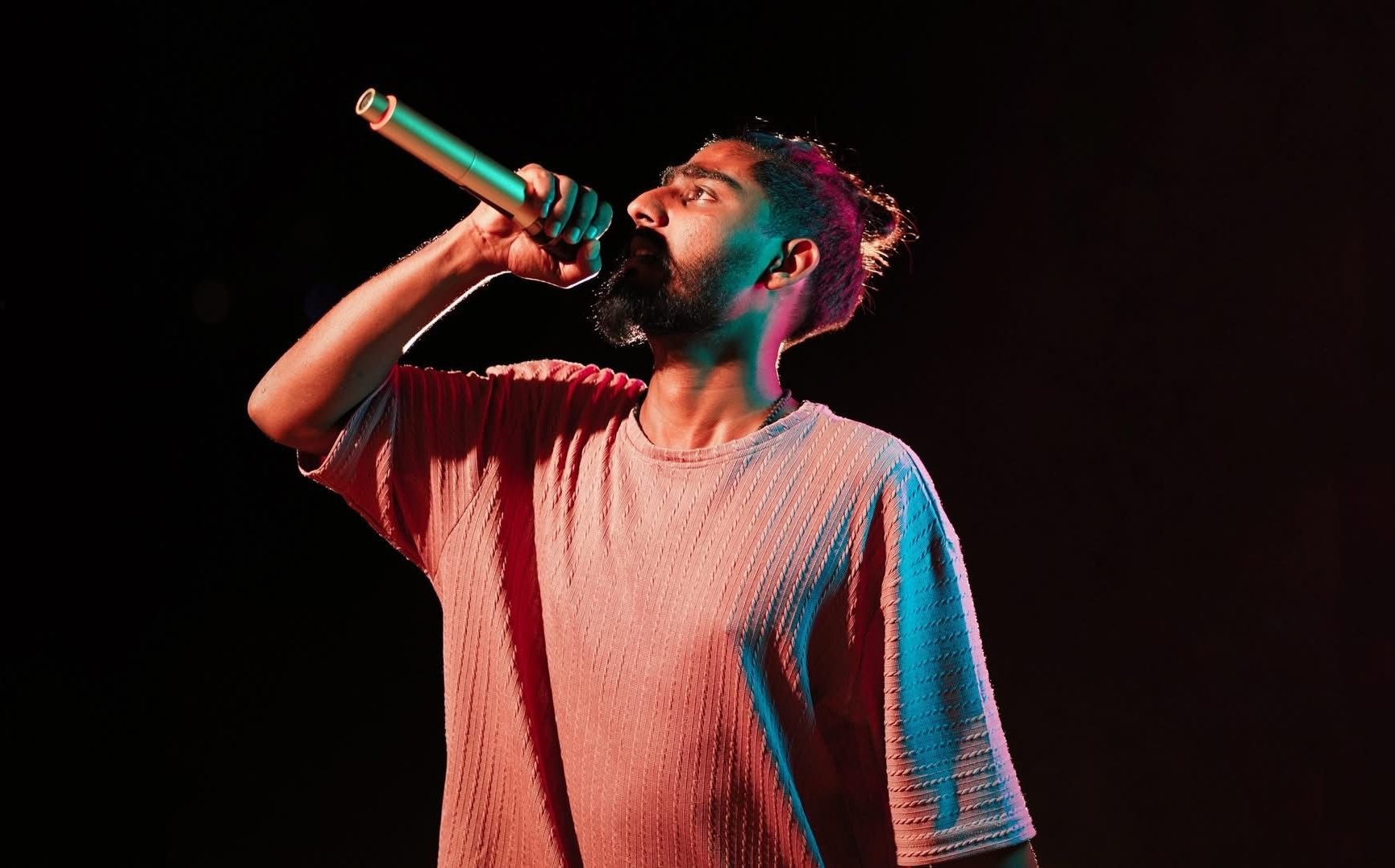
When officers of the Jaffna District Crime Prevention Division arrested a 24-year-old rapper from Kilinochchi on 2 June over videos of a music performance, they invoked one of the most feared pieces of legislation on the island: the Prevention of Terrorism Act (PTA).
Within days, the case of Sangeethsan Ganeskumar, known to his audience as Hiphop Sangee, had grown from a local arrest into an international controversy, drawing in parliamentarians, lawyers before the Supreme Court, organisations across continents, the mayor of a Canadian city, Amnesty International and the European Union.
It became, in the space of a fortnight, the latest and one of the clearest illustrations of how a law that successive Sri Lankan governments have promised to repeal continues to be turned against Tamil cultural and political expression.
What happened
On 31 May, Sangeethsan performed at a temple festival in Navatkuli, in the Chavakachcheri area of Jaffna. The following day he uploaded footage of the performance to social media, including audio of him rapping a song with Tamil nationalist lyrics. Sri Lankan police alleged that the material was sympathetic to the Liberation Tigers of Tamil Eelam (LTTE), the movement defeated by the Sri Lankan military in 2009, and that by editing and reposting it Sangeethsan had attempted to promote or even revive a proscribed organisation.
See the video he uploaded, which is still available to view on his social media, below.
He was arrested on 2 June by the Jaffna Divisional Criminal Investigation Bureau under Section 03 of the PTA and produced before the Jaffna Magistrate's Court, which ordered him remanded until 17 June. He later said that until his arrest he had not understood that editing and sharing such content online could expose him to prosecution.
See more, including the English translation of the lyrics, here.
A timeline of the case
Late May Police interrupt a performance in Urumpirai and summon musician Gokulan over homeland-themed songs, days before Sangeethsan's arrest.
31 May Sangeethsan performs at a temple festival in Navatkuli, Chavakachcheri.
1 June He uploads edited footage of the performance, featuring war-era songs, to social media.
2 June He is arrested under the PTA by the Jaffna Divisional Criminal Investigation Bureau and remanded until 17 June.
3-6 June Protests erupt in Kilinochchi, Valvettithurai, Vavuniya, Mannar and elsewhere across the North-East. Tamil and Sinhala parliamentarians raise the case. Similar protests take place in Paris and London.
9 June In parliament, ITAK MP Sivagnanam Shritharan condemns the arrest, while Public Security Minister Ananda Wijepala says there will be no room for activities promoting the LTTE and signals that fresh charges may follow.
9 June M. A. Sumanthiran PC and lawyer K. Sayanthan visit Sangeethsan in prison; a fundamental rights petition is prepared for the Supreme Court.
10 June Kerala rapper Vedan raises the case with Tamil Nadu minister Vanni Arasu; international condemnation grows.
11 June ITAK group leader Shanakiyan Rasamanickam raises the case with the European External Action Service in Brussels, linking it to Sri Lanka's GSP+ obligations.
12 June The Attorney General withdraws the PTA charge and proceeds under Section 120 of the Penal Code. The Chavakachcheri Magistrate's Court grants bail under strict conditions.
'Where is the LTTE?'
From the outset, the legal basis of the arrest was contested. Appearing before the Jaffna Magistrate's Court, Sangeethsan's lawyer argued that the poem and the material cited by police contained no reference whatsoever to the LTTE, its symbols or its leadership. References to lions and tigers, the defence noted, could not in themselves constitute evidence of support for a banned movement, and parties bearing the words "Tamil Eelam" and "Viduthalai Pulikal" had been registered with Sri Lanka's Election Commission. The question the defence posed, in effect, was where in the material the prosecution had actually found the LTTE.
The case quickly came to stand for something larger than one performance. For Tamils in the North-East, it was a familiar pattern: the invocation of the LTTE, nearly seventeen years after the end of the war, to police what Tamils may sing, say, write or commemorate. Critics pointed out that the same standard was not applied to the governing party itself. Tamil Progressive Alliance leader Mano Ganesan noted that National People's Power politicians had circulated songs glorifying the LTTE during election campaigns, and an NPP parliamentarian acknowledged that revolutionary songs had appeared on the party's own social media during the campaign.
The response at home
The arrest triggered demonstrations across the Tamil homeland. Protests were held in Kilinochchi, Valvettithurai, Vavuniya and Mannar, drawing students, artists, civil society groups and the families of the disappeared.
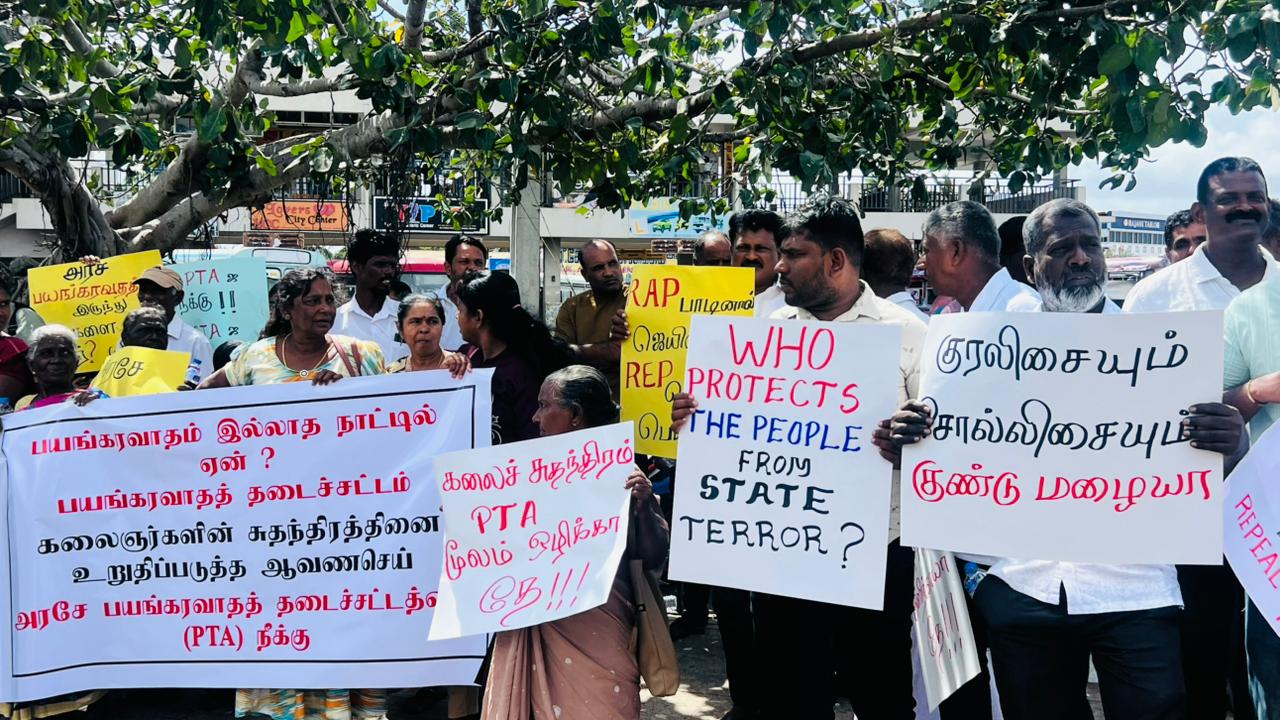
Protestors in Mannar.
In parliament, ITAK MP Sivagnanam Shritharan condemned the arrest, declaring that the right to sing, to speak, to write and to gather were all being restricted, and warning of a large-scale North-East protest if Sangeethsan was not released. His colleague Shanakiyan Rasamanickam submitted a private member's motion calling for the full repeal of the PTA.
The legal response was led by President's Counsel M. A. Sumanthiran, who, together with lawyer K. Sayanthan, visited Sangeethsan in prison and announced that a fundamental rights petition would be filed before the Supreme Court.
The government's own position hardened in public even as it shifted in practice: police defended the arrest, and Public Security Minister Ananda Wijepala told parliament there would be no room for activities promoting the LTTE, while signalling that fresh charges could be brought.
The response abroad
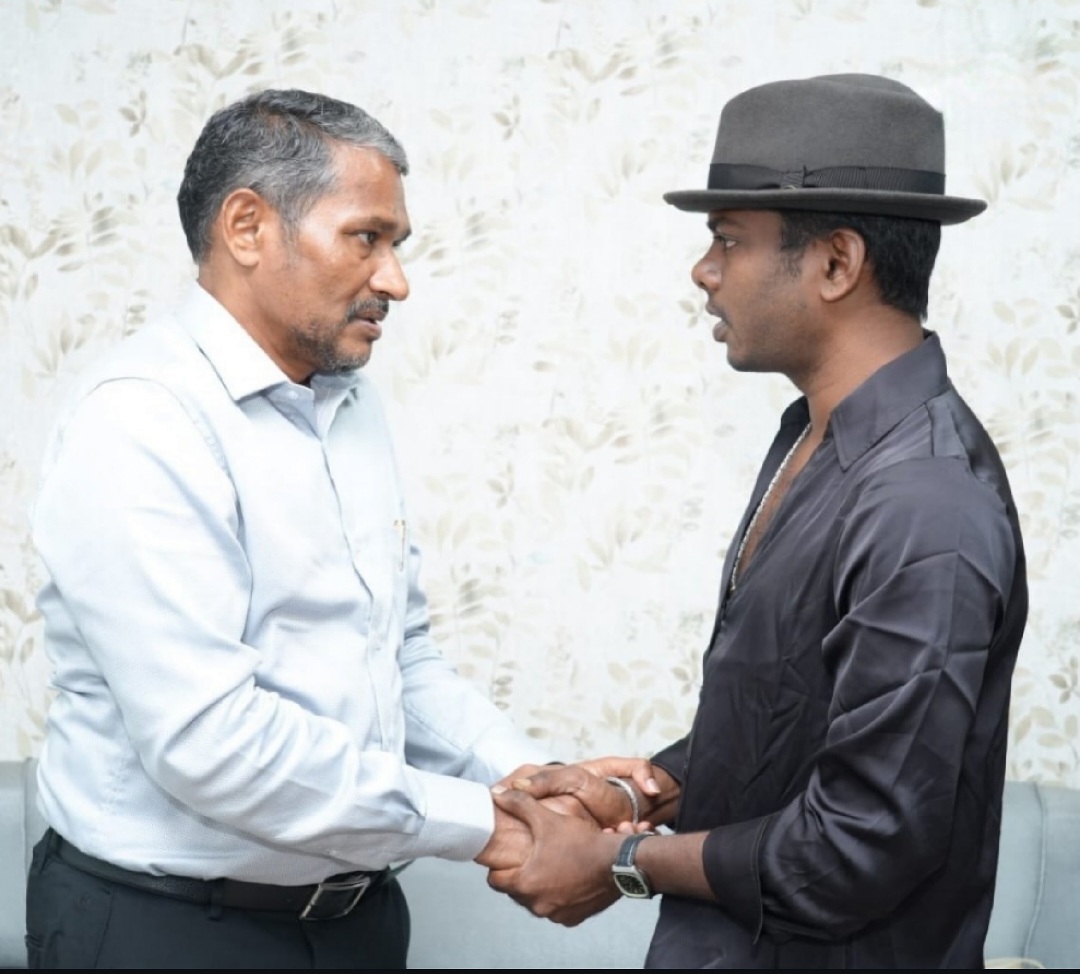
Rapper Vedan with Vanni Arasu.
The case rapidly drew international attention. In India, Kerala rapper Vedan raised the arrest in a meeting with Tamil Nadu Social Justice Minister Vanni Arasu, while Naam Tamilar Katchi leader Seeman demanded Sangeethsan's release, questioning how a song could be treated as a security threat. In Canada, the mayor of Brampton, Patrick Brown, called for his immediate release, and the Tamil Youth Organization Canada and twelve Tamil students' associations issued a joint condemnation.
In Britain, the Tamil Youth Organisation UK condemned the arrest, framing it as part of the ongoing criminalisation of Tamil artistic and cultural expression and calling on the international community to hold Sri Lanka to account for its continued use of the PTA, whilst a protest was held outside the Sri Lankan High Commission.
Amnesty International cited Sangeethsan's case in renewed calls for the immediate repeal of the PTA, noting that the law's broad and vaguely defined offences do not align with international legal standards.
The arrest was raised with the European Union directly when Rasamanickam met the European External Action Service in Brussels, warning that the continued use of the PTA bears directly on Sri Lanka's eligibility for the GSP+ trade concession, which is conditional on compliance with international human rights commitments.
Released, but not cleared
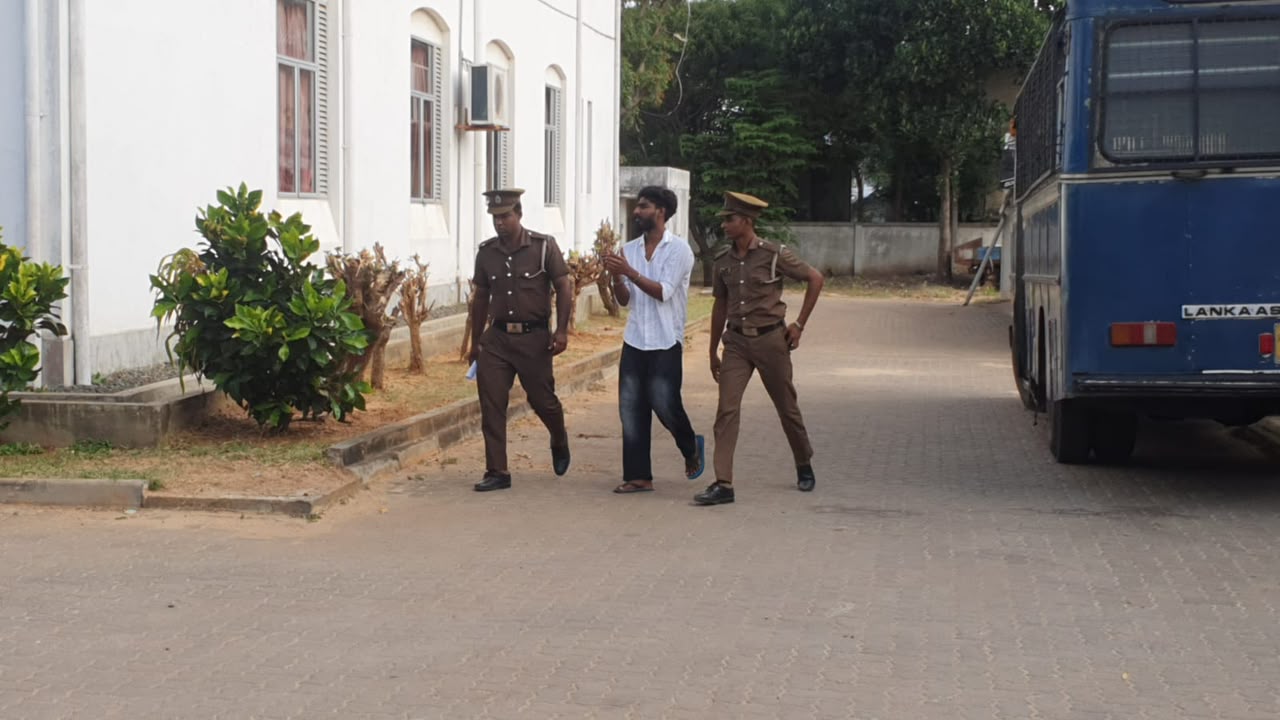
Sangee, on his way to being bailed on Friday.
On 12 June, the case took a decisive turn. The Attorney General withdrew the PTA charge and moved instead to proceed under Section 120 of the Penal Code, the lesser offence of exciting disaffection. The Chavakachcheri Magistrate's Court then granted Sangeethsan bail under strict conditions. The case was called three times that day owing to a delay in the Attorney General's written undertaking reaching the court, and, to the surprise of those present, a new counsel appeared with the consent of Sangeethsan's mother to hand it over.
The shift away from the PTA was significant. Section 120 does not carry the sweeping detention powers of the Prevention of Terrorism Act, under which suspects can be held for extended periods without charge, and the move amounted to a tacit acknowledgement that the original terrorism charge could not be sustained. Tamil commentators attributed the climbdown to the scale of the protests and the pressure brought to bear domestically and internationally. The matter had been raised in parliament, in the courts, in Brussels and across the diaspora, and the government, facing scrutiny of its GSP+ obligations and its own unkept promises on the PTA, retreated from the terrorism charge.
However, the case is not closed. Sangeethsan has been released on bail, not acquitted, and the investigation continues under the Penal Code.
A chilling effect
The significance of Sangeethsan's arrest extends well beyond his own ten days in a cell.
For Tamil artists in the North-East, the case has sharpened an already pervasive sense that to sing, write or perform about the homeland, the war or the dead is to risk the attention of the security forces. The message that an edited video of a temple performance can result in a terrorism charge is, for many musicians and writers, a warning to self-censor, and it lands in a climate where the policing of Tamil expression had already intensified sharply.
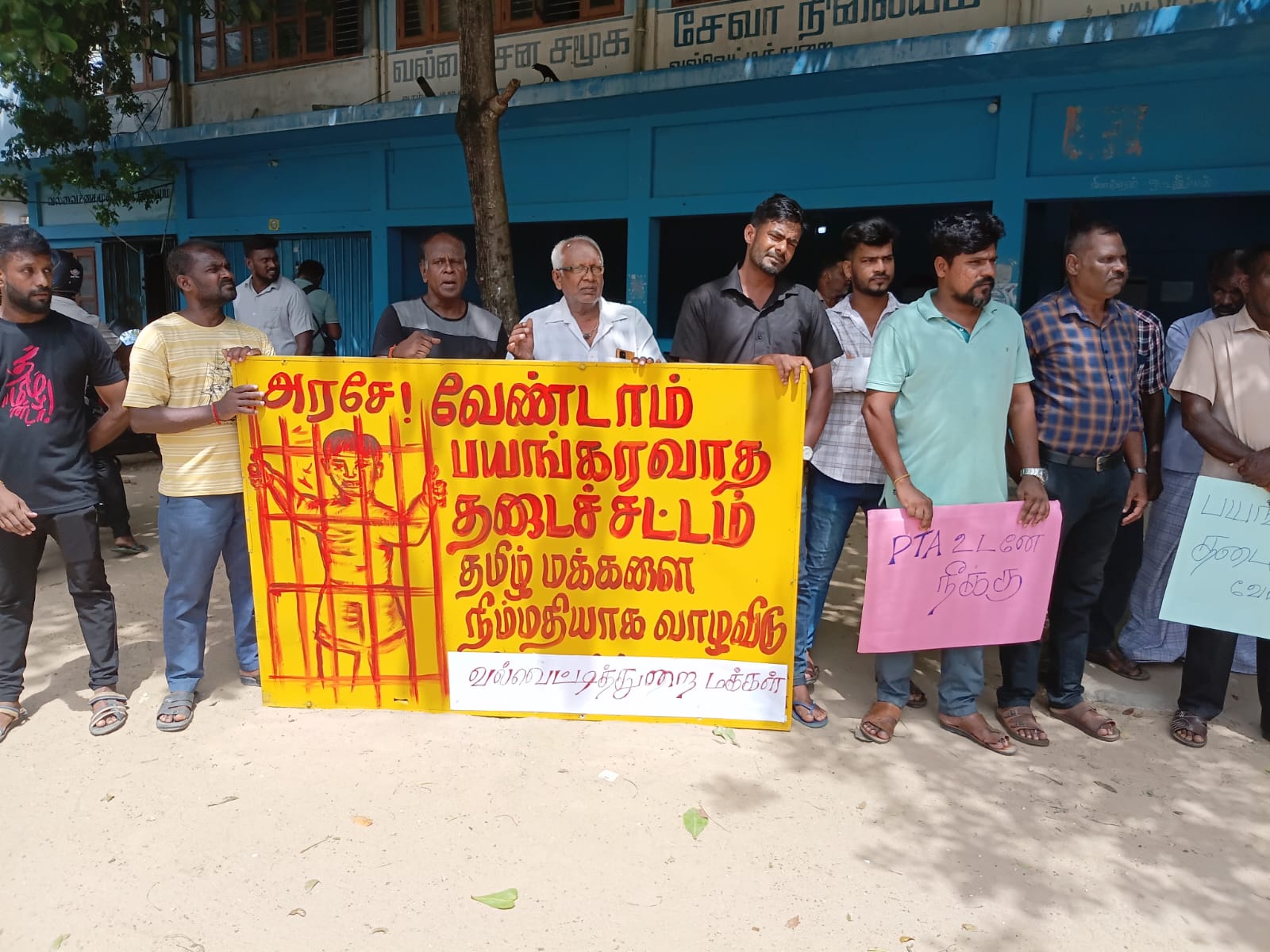
Protestors in Jaffna last week.
The examples are recent and numerous. In the week before Sangeethsan's arrest, police interrupted a musical event in Urumpirai, Jaffna, and summoned Gokulan, the son of the late and celebrated Tamil musician S. G. Santhan, for questioning over homeland-themed songs. Those questioned pointed out that not every song produced in the homeland during the armed conflict was connected to the LTTE, and that the period had also produced love songs, devotional songs and works reflecting the grief, displacement and suffering of war-affected Tamils. The artist's own response captured the absurdity of the policing: the issue, he said, was not the songs, which are played freely on stages everywhere, but that it was Tamils who were singing them.
The pattern is consistent. Tamil writer Theepachelvan Piratheepan had copies of several of his books confiscated by customs authorities over their focus on the armed conflict, with officials alleging the works threatened "national harmony".
During Maaveerar Naal in November 2025, Sri Lankan police seized sound equipment in Mallakam for playing remembrance songs, confiscating speakers as "evidence", while in Uduthurai officers summoned commemoration organisers and ordered them to play cinema songs instead of Maaveerar songs, banning even the karthigai flower of remembrance. Taken together, these incidents describe a state apparatus that treats Tamil music, literature and memorialisation as inherently suspect.
It was this wider context that diaspora and civil society groups sought to name. The Tamil Youth Organization Canada and the twelve student associations that condemned the arrest placed it explicitly within a campaign against artistic expression, arguing that by criminalising music, poetry and digital art the Sri Lankan state sought to censor the lived experiences of Tamils, criminalise their collective grief and deny them the right to articulate their identity. The fear, artists and organisers across the North-East have warned, is not only of arrest but of the slow narrowing of what it is permissible for a Tamil to create or express at all.
The law that refuses to be repealed
For all the specificity of Sangeethsan's case, the underlying grievance is an old one.
The Prevention of Terrorism Act was introduced in 1979 as a temporary measure and made permanent in 1982. Over more than four decades it has enabled arbitrary arrests, prolonged detention without charge and, in numerous documented cases, torture, with Tamils, Muslims, journalists, writers and activists disproportionately affected. Both before and during the 2024 election, the National People's Power (NPP) pledged to abolish the law and replace it with legislation compliant with international standards.
Nearly two years later it remains in force, and the government has spoken instead of introducing a replacement law that critics, including Rasamanickam, have warned could prove more draconian than the act it succeeds.
Sangeethsan walked out of the Chavakachcheri court a man on bail, but the law that put him in a cell for ten days remains exactly where it was.
For the Tamils who filled the streets of the North-East to demand his release, that is the point that endures: a young man was jailed for a song, the instrument that allowed it is still on the statute books, and a chilling warning has been sent to everyone across the Tamil homeland.