
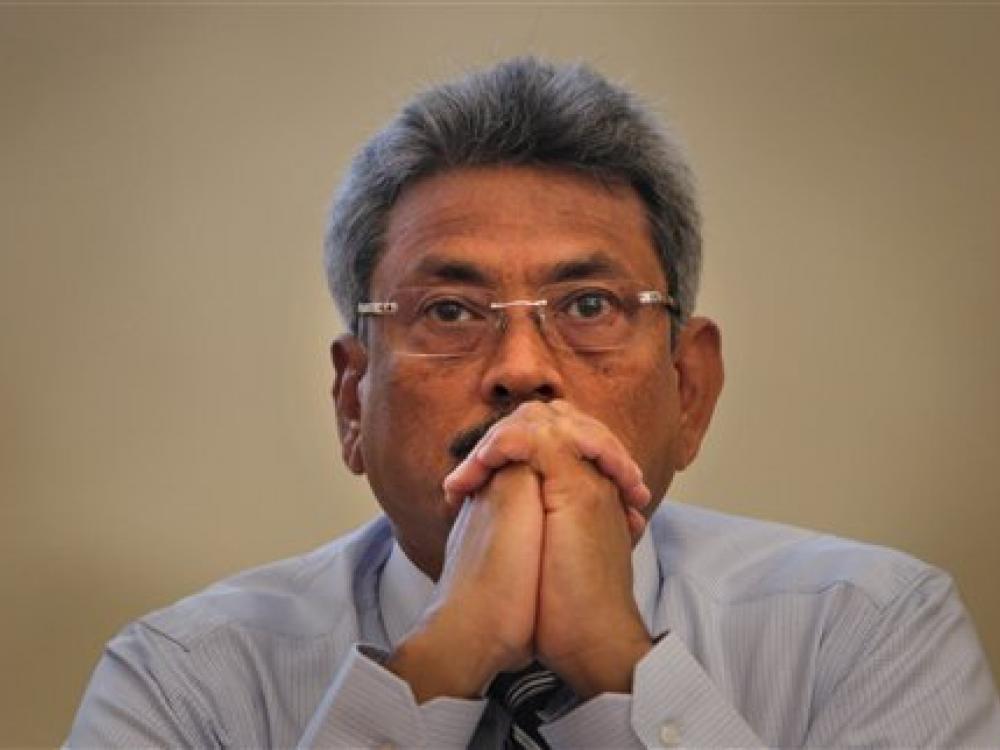
Former Sri Lankan President and credibly accused war criminal Gotabaya Rajapaksa has informed the Supreme Court that he is willing to testify in the habeas corpus case relating to the 2011 enforced disappearance of human rights activists Lalith Weeraraj and Kugan Muruganandan - but has requested that proceedings be held in Colombo, citing “security concerns.”
The announcement was made on Tuesday during a Supreme Court hearing on an appeal filed by the victims’ families. Rajapaksa’s legal counsel, President’s Counsel Romesh de Silva, told the court that the former president was ready to provide evidence, but sought to do so before a Magistrate’s Court in Colombo rather than in Jaffna, where the summons was originally issued.
Attorney-at-Law Nuwan Bopage, representing the parents of the missing activists, said they had no objection to the requested change of venue. The three-judge Supreme Court bench, Justices Yasantha Kodagoda, Kumuduni Wickremasinghe, and Shiran Gooneratne, instructed that a motion be filed with the Jaffna Magistrate’s Court within four weeks, allowing the court to issue new directions based on Rajapaksa’s updated stance. The Supreme Court subsequently dismissed the appeal.
The case concerns the disappearance of Lalith Weeraraj and Kugan Muruganandan, members of the Frontline Socialist Party, who went missing on 9 December 2011 while organising a press conference in Jaffna to mark International Human Rights Day. The pair were last seen leaving Muruganandan’s home in Avarangal at around 5 p.m. They have not been seen or heard from since.
At the time of the incident, Gotabaya Rajapaksa was serving as Sri Lanka’s Defence
Secretary, a post he held during the final phase of Mullivaikkal genocide. His tenure oversaw the massacres at Mullivaikkal in 2009, during which tens of thousands of Tamils were killed, atrocities that are being increasingly recognised as genocide.
The Jaffna Magistrate’s Court had previously issued a summons requiring Rajapaksa to testify as part of the habeas corpus inquiry into the activists’ disappearance. However, in a 2019 ruling, the Court of Appeal quashed that order. The families of the victims later challenged the decision, resulting in the current appeal.
Rajapaksa, who fled the country in 2022 following mass protests against his administration and later returned, has consistently avoided testifying in cases involving wartime abuses and enforced disappearances. In October 2024, he refused to travel to Jaffna to provide testimony in this case, once again citing security concerns
Despite repeated calls from Tamil families and international rights groups, Rajapaksa has never been held accountable for his role in the Mullivaikkal genocide or the state’s campaign of enforced disappearances, torture, and mass detention. The case of Lalith and Kugan remains one of many unresolved disappearance cases, underscoring the continued failure of Sri Lanka’s justice system to deliver accountability.
