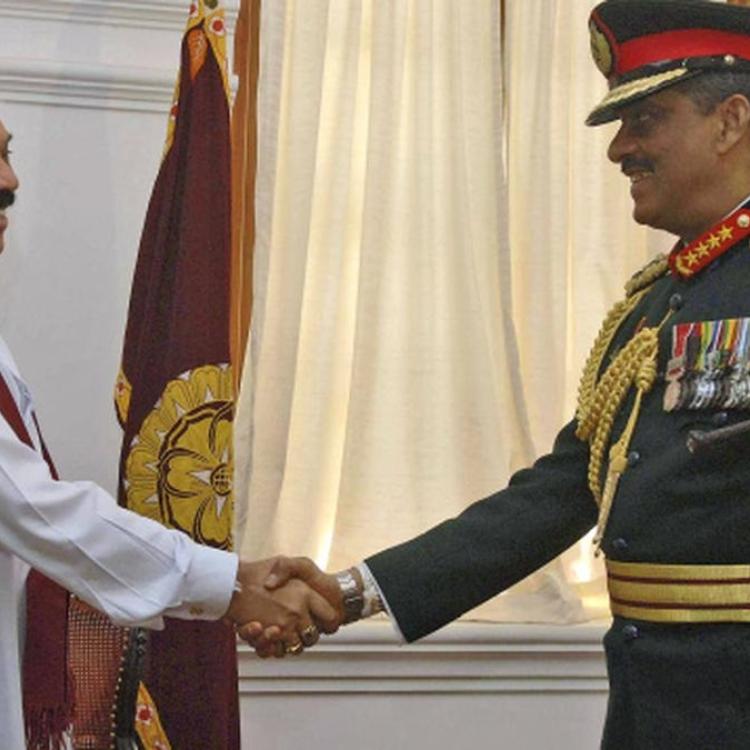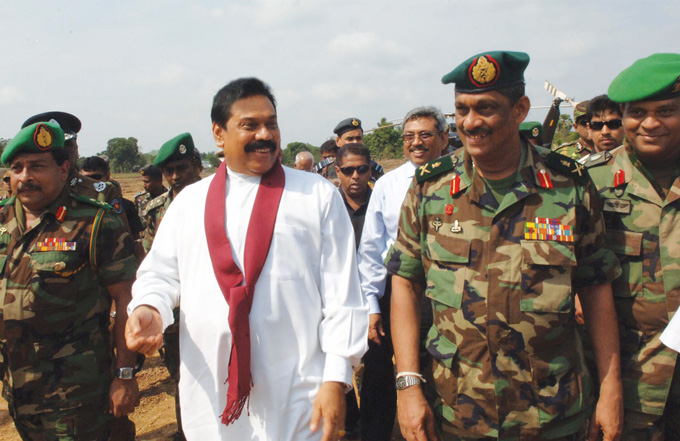
Fonseka alongside Rajapaksa in 2009.
Former Sri Lankan army commander and accused war criminal Sarath Fonseka expressed “respect” Liberation Tigers of Tamil Eelam (LTTE) leader Velupillai Prabhakaran, claiming that he refused to flee the battlefield during the final stages of the armed conflict in 2009.
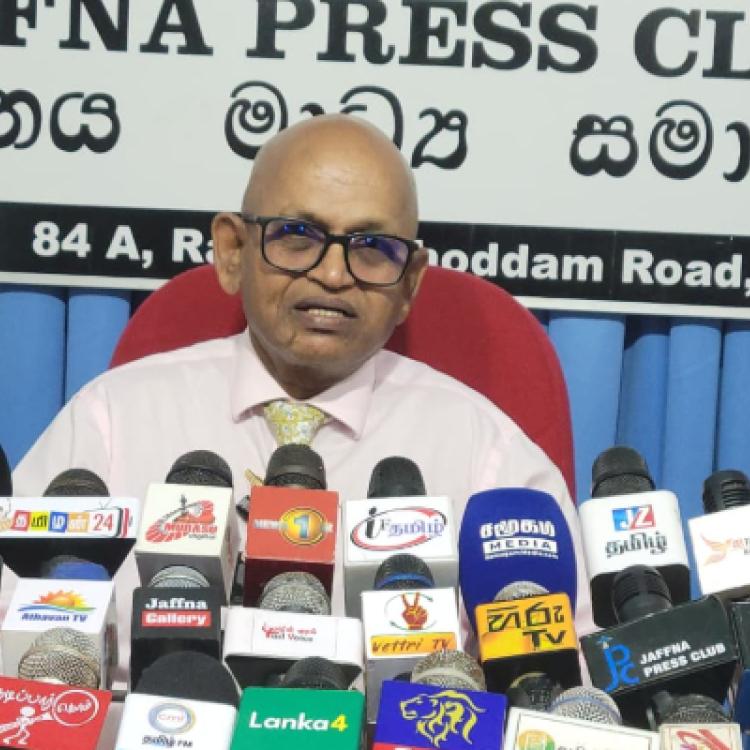
“Though the leader of the LTTE was our adversary, he did not flee; he fought till the very end,” Fonseka told reporters. “For that, I continue to accord him the honour he deserves. He did not run away from the battlefield but faced the final battle steadfastly. Therefore, as a former Army Commander, I have always held a special respect for him for that reason.”
Fonseka’s comments come amid renewed scrutiny of his relationship with the Rajapaksa family, with whom he fell out following the end of the armed conflict in 2009. Tens of thousands of Tamils were killed at the time, in what is being increasingly recognised as a genocide, led by the Rajapaksa family and Fonseka.
In remarks to reporters, the former army commander levelled accusations against the Rajapaksas, alleging that they funded the LTTE, profited from wartime deals, and were responsible for the deaths of Sri Lankan soldiers during the final months of the genocide.
He revealed that during the war, when Sri Lankan forces faced a severe shortage of artillery shells after China stopped its ammunition supply, he informed then Defence Secretary Gotabaya Rajapaksa of the crisis. Gotabaya allegedly told him that the munitions had been purchased on credit, and that “nothing could be done” if China halted the shipments. Fonseka claimed that following this exchange, Basil Rajapaksa intervened, phoning B. P. Jayasundara to urgently release USD 100 million to the army. The money was reportedly transferred within minutes, after which Basil and Fonseka shared “an hour of friendly conversation.”
Fonseka went on to recall that in 2005, Basil Rajapaksa had publicly admitted to supporting the LTTE in calling for a boycott of the presidential election, ensuring Mahinda Rajapaksa’s victory. According to Fonseka, funds were channelled through a foreign country to purchase Tora-style attack boats for LTTE maritime units, which were later used to attack the Sri Lankan navy. Fonseka described it as “treason.”
He accused Mahinda Rajapaksa of hypocrisy, noting that although Mahinda’s son Yoshitha Rajapaksa served in the navy, “he never went to sea to fight.”
Fonseka also alleged that Mahinda Rajapaksa personally ordered a ceasefire on 31 January and 1 February 2009, which prolonged the conflict and cost the lives of over a thousand Sri Lankan soldiers. “The war should have ended by mid-March,” he said, “but it continued until May, costing unnecessary lives. For that, Mahinda Rajapaksa is responsible.”
He further accused the former president of issuing false statements denying that he had ordered a ceasefire and claimed that the Rajapaksa brothers had “repeatedly attempted to derail the conflict.”
“Some call Mahinda a lion,” Fonseka said, “but he is a coward and a traitor. He funded the LTTE and is responsible for the great loss of life. Legal action should be taken against him.”
Fonseka also accused Gotabaya and Mahinda Rajapaksa of misusing state property, including removing large quantities of timber from the official residence at Wijerama.
He went on to claim that on 17 May 2009, a meeting took place between Mahinda, Gotabaya, Basil Rajapaksa, and Erik Solheim, during which they discussed how to end the war. Fonseka said it was suggested that LTTE leaders might surrender under white flags, but that his stance had been “unequivocal” - the war should only end with the elimination of the LTTE.
He concluded his remarks by once again referring to Prabhakaran, saying, “If Prabhakaran were alive today, he would have been granted a ministerial post in Mahinda’s government.” Fonseka added that former LTTE figures such as K. P. Pathmanathan and Pillayan remained active in politics, and reiterated his belief that the Rajapaksas had betrayed both the country and their own soldiers for personal and political gain.