.JPG)
Tamil parliamentarian Sivagnanam Shritharan has once again drawn attention to what he described as entrenched discrimination in the Sri Lankan state’s handling of land disputes and places of worship in the North-East, highlighting the destruction of Saiva temples and Christian churches under military occupation.
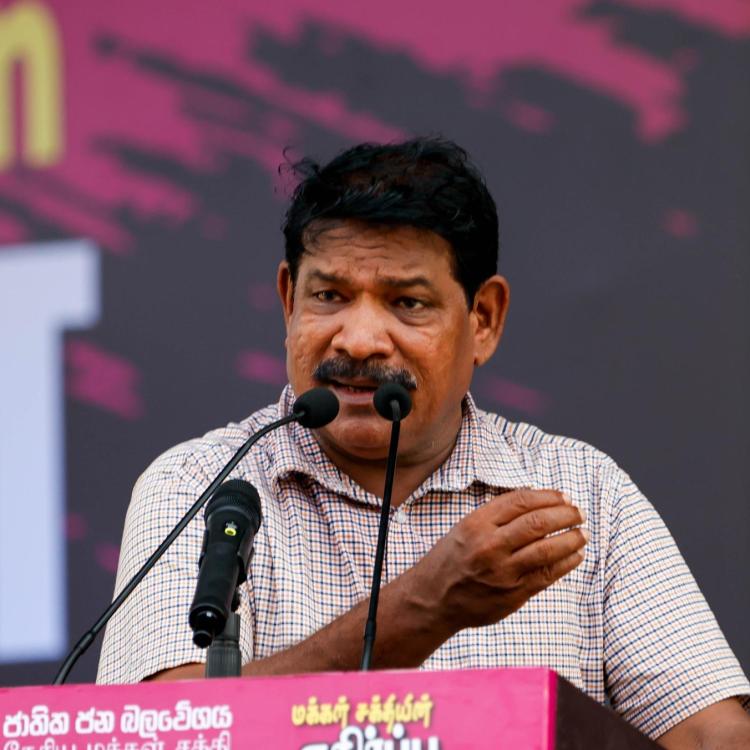
Speaking in parliament earlier this month, Shritharan detailed how numerous historic Tamil religious sites in the Jaffna peninsula had been demolished after the end of the armed conflict, while Sinhala Buddhist structures continue to be protected and expanded.
"If Kovils, Hindu places of worship and Saiva temples can be smashed and destroyed, what is wrong in demolishing a Buddhist temple erected by force?" @ImShritharan charges government of continuing with double standards in the treatment of different nationalities in Sri Lanka. pic.twitter.com/pF68Tig3Cw
— LankaFiles (@lankafiles) January 8, 2026
“In the north there were Hindu temples until 2010 in Myliddy Tholagatty, Thaiyiddy, Palaly and Vasavilan,” Shritharan told parliament. Holding up a photograph taken by residents in 2010, he pointed to the image of the Varasiththi Vinayagar Kovil in Myliddy.
“That kovil has been blown to smithereens,” he said. “No sign left.”
He then referred to another historic site, presenting a photograph of the Holy Sacrament Church in Myliddy.
“After 2010, this well preserved church, that was a 150-year-old church with an architectural significance, has also been destroyed by the military,” he stated.
Drawing attention to what he described as blatant hypocrisy in state conduct, Shritharan posed a sharp question to the chamber.
“If such kovils, Hindu places of worship and Saiva temples can be smashed and destroyed, what is wrong in demolishing a Buddhist temple erected by force?” he asked.
His remarks were aimed at highlighting the unequal manner in which religious heritage is treated in the Tamil homeland. Shritharan stressed that Hindu and Christian structures have been erased with impunity, while any challenge to Sinhala Buddhist encroachment is immediately condemned and criminalised.
“You can wreck and uproot Hindu kovils. You can destroy Catholic churches. But for Buddhist temples,” he said, leaving the sentence unfinished to underline the contradiction.
Shritharan went on to link this pattern to the continuing military occupation of the North-East.
“The north and east is retained by the military. The people are under the total oppression of the military. That is a difference. It needs to be removed first.”
Tamil politicians and civil society groups have long documented how the Sri Lankan military has demolished Tamil religious sites in high security zones and occupied areas, while simultaneously enabling the construction of new Sinhala Buddhist shrines on seized lands. These actions have been widely viewed as part of a broader process of structural Sinhalisation of the Tamil homeland.